
How to Query Your Database in Plain English – No SQL Required


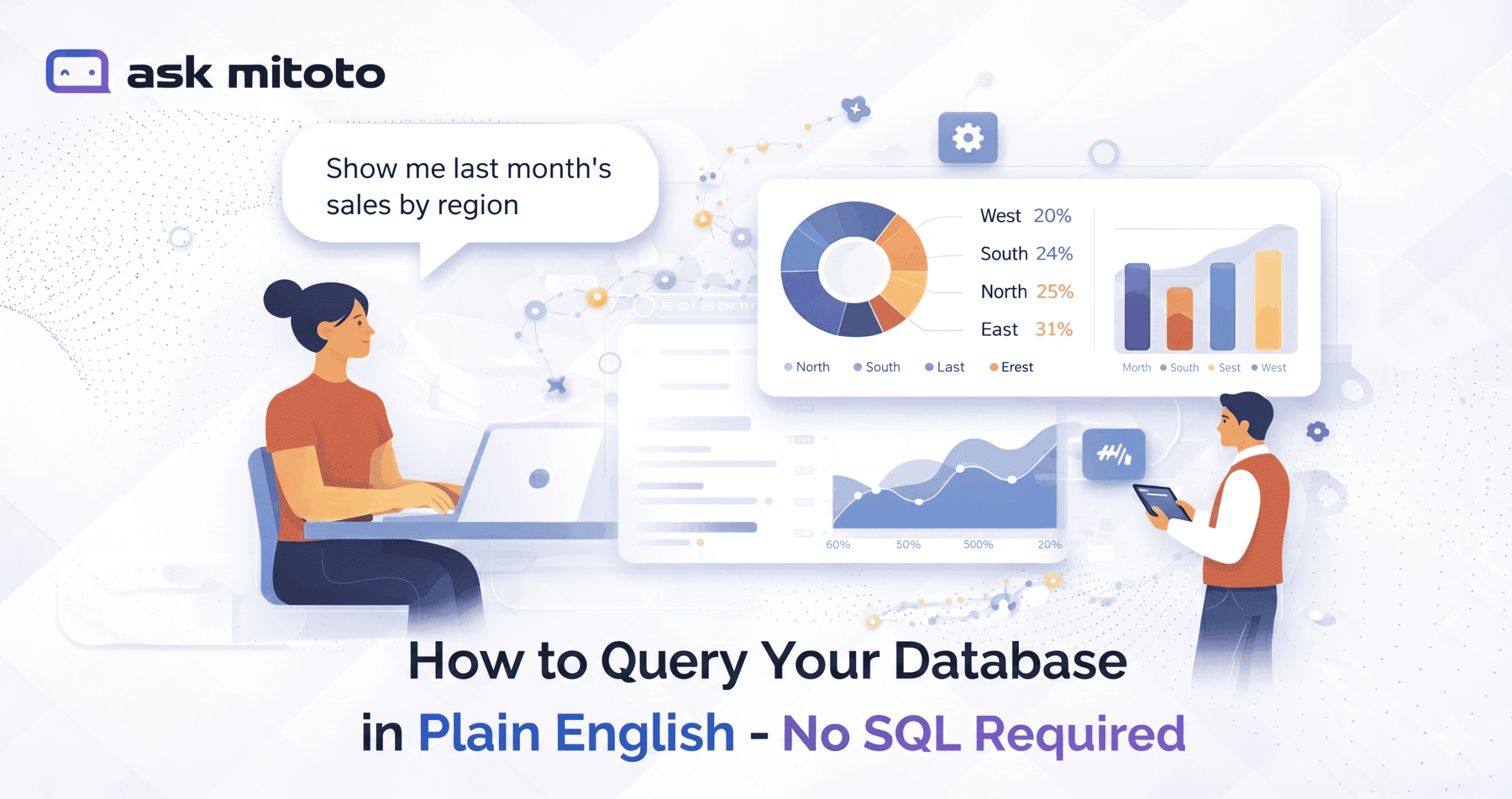
Have you ever needed a quick answer from your company’s database – a sales number, a customer count, a monthly trend – but had to wait hours (or days) for someone from the data or IT team to pull it for you?
You are not alone.
For most business owners, managers, and non-technical professionals, getting data out of a database has always meant one thing: SQL. And for most of us, SQL might as well be a foreign language. You know the data is in there. You just cannot touch it.
That is changing fast. Thanks to modern AI, you can now query your database in plain English – no SQL knowledge required. You simply type your question the same way you would ask a teammate, and the AI gives you the answer.
In this guide, we will walk you through exactly how natural language database querying works, why it matters for your business, and how a tool like Ask Mitoto makes it possible for anyone – technical or not – to have a real conversation with their data.
What Does It Mean to Query a Database in Plain English?
A database query is simply a request for information. Traditionally, that request had to be written in Structured Query Language, or SQL – a rigid, rule-based programming syntax that looks something like this:
SELECT customer_name, SUM(order_value) FROM orders WHERE order_date >= ‘2024-01-01’ GROUP BY customer_name ORDER BY SUM(order_value) DESC;
That query answers a simple question: “Who are my top customers by order value this year?” But writing it correctly requires knowing table names, column names, SQL syntax, and the logic of joins, filters, and aggregations. For non-technical users, that is a significant barrier.
Natural language database querying removes that barrier entirely. Instead of writing SQL, you simply type:
“Who are my top customers by order value this year?”
The AI understands what you are asking, translates it into the correct SQL behind the scenes, runs it against your database, and returns a clean, readable answer – in seconds.
This is what tools like Ask Mitoto are built for.
Why Non-Technical Database Access Is a Big Deal in 2026
The average mid-size business today uses over 130 SaaS applications, and almost all of them generate data. CRM data, sales data, inventory data, customer support data – it is all sitting in databases. The problem is that only a small slice of any team – the data analysts and engineers – can actually access and interpret it.
This creates a bottleneck. Business decisions slow down. Teams rely on gut instinct instead of real numbers. Analysts spend most of their time answering repetitive data requests instead of doing strategic work.
Natural language query (NLQ) technology solves this by making data self-service. Non-technical users – sales managers, marketing leads, finance teams, operations staff – can explore data independently without needing to learn SQL or depend on a technical team for every insight.
Here is what that means in practice:
- A sales manager can ask, “What were our top-performing products in Q1?” and get an answer in ten seconds
- A finance lead can ask, “Show me monthly revenue compared to last year,” without opening a ticket
- An operations head can ask, “Which suppliers had the most delays last quarter?” without writing a single line of code
This is the shift from data as a technical function to data as a business capability – and it is one of the biggest trends reshaping how companies operate right now.
How Natural Language to SQL Technology Actually Works
You might be wondering: how does the AI know what you mean?
When you type a question in plain English, the AI model processes your input using Natural Language Processing (NLP) – a branch of AI that helps computers understand human language. It identifies what you are asking for (intent), maps your words to the relevant tables and columns in your database (schema awareness), and generates a precise SQL query that retrieves exactly what you need.
Modern AI systems – including the one powering Ask Mitoto – are particularly good at this because they are trained on vast amounts of language and data patterns. They understand context, synonyms, and even ambiguous phrasing.
For example, if you ask “How many new sign-ups did we get last month?” The AI understands that “sign-ups” likely refers to a users or registrations table, that “last month” is a dynamic date filter, and that “how many” means a COUNT operation. It puts all of this together and generates an accurate SQL query automatically.
The result shows up as a clean number, a table, or a summary – not a wall of code.
The Old Way vs. The New Way: A Side-by-Side Look
The old way – SQL-dependent workflow:
- A manager needs data
- They write a request and send it to the data team
- The analyst interprets the request, writes the SQL, and runs the query
- Results come back hours or days later
- If the question changes, the cycle repeats
The new way – natural language database query with Ask Mitoto:
- A manager types their question in plain English
- Ask Mitoto’s AI translates it to SQL and runs it instantly
- The answer appears in seconds
- The manager asks a follow-up question and gets another instant answer
The difference is not just speed. It is autonomy. When teams can ask their own data questions without waiting on analysts, decision-making becomes faster, more frequent, and more accurate.
What Kinds of Questions Can You Ask?
One of the most common questions people have about no-code database querying tools is: what kinds of questions can it actually answer?
The short answer is: almost anything your data contains.
Ask Mitoto SQL AI chatbot is designed to handle a wide range of business queries across industries. Here are some real examples of questions you can ask in plain English:
Sales and Revenue
- “What was our total revenue last quarter?”
- “Which sales rep closed the most deals in March?”
- “Show me our month-over-month revenue growth for the past year.”
Customer Data
- “How many active customers do we have right now?”
- “Which customers have not placed an order in the last 90 days?”
- “What is the average order value by customer segment?”
Operations and Inventory
- “Which products are currently below restock threshold?”
- “What is our average delivery time by region?”
- “Show me the top 10 most returned products.”
Marketing and Engagement
- “How many leads came from organic search last month?”
- “What is our email open rate by campaign?”
- “Which referral source drives the highest conversion rate?”
If your database has the data, Ask Mitoto can help you get to it – in plain English, without touching a line of SQL.
How Ask Mitoto Makes Natural Language Database Querying Simple
Ask Mitoto is built specifically for businesses that want to unlock their data without the complexity of traditional business intelligence tools or the dependency on SQL-savvy staff.
Here is how it works:
Step 1: Connect your database. Ask Mitoto connects securely to your existing database – whether it is MySQL, PostgreSQL, or another SQL-based system. Setup is straightforward and does not require developer involvement for most standard database types.
Step 2: Ask your question. Once connected, you simply type your question in the chat interface – just as you would ask a colleague. There is no need to know table names, write joins, or think about query structure.
Step 3: Get your answer instantly. Ask Mitoto’s AI reads your question, understands the intent, generates the appropriate SQL query, executes it against your database, and returns the result – usually in seconds. You can ask follow-up questions, drill into specific numbers, or export results for further use.
The experience feels less like running a database query and more like having a conversation with someone who knows your data inside and out.
Is It Safe to Connect Your Database to an AI Tool?
This is one of the most important questions to ask – and a fair one.
Data security is a top priority for any business, and the idea of connecting your database to an external AI system understandably raises concerns.
Ask Mitoto is designed with data privacy and security in mind. The tool operates on a read-only basis for query functions – it retrieves data, but does not write, modify, or delete anything in your database. Access is controlled through your existing database credentials and permissions, meaning the AI can only see what your credentials allow it to see.
For businesses handling sensitive data, it is also worth knowing that modern NLQ tools do not store your raw database contents. The AI processes your query and your database schema (the structure, not the data itself) to generate accurate SQL – it does not retain or expose your proprietary data beyond the scope of your query session.
If you have specific compliance requirements – such as GDPR, HIPAA, or SOC 2 – it is always recommended to review a vendor’s data processing documentation before connecting production databases. Ask Mitoto’s team to walk enterprise customers through their security architecture.
Who Benefits Most from Plain-English Database Querying?
Natural language database querying is valuable across virtually every business function, but some roles benefit particularly quickly:
Small business owners who wear many hats and need fast answers without hiring a data analyst. Being able to ask “How much did we make last week?” and get an instant answer is a genuine operational advantage.
Sales and revenue leaders who need real-time performance data without waiting for reports. Tracking pipeline, deal velocity, and rep performance becomes as easy as asking a question.
Marketing teams want to understand campaign performance, attribution, and audience behavior without relying on a data team to pull reports every time.
Finance and operations managers who need accurate numbers for planning, forecasting, and reporting – but do not have the technical background to pull them independently.
Startup teams where everyone is a generalist and there is no dedicated data analyst. Ask Mitoto gives the whole team access to data insights from day one.
Common Myths About Natural Language Database Queries – Debunked
Myth 1: “You still need to know some SQL to use it.” Not with modern tools like Ask Mitoto. The AI handles all query generation. You just need to know what question you want answered.
Myth 2: “It only works for simple questions.” Today’s NLQ systems can handle surprisingly complex queries – multi-table lookups, conditional filters, date-based aggregations, and more. The AI is designed to interpret business-level questions, not just simple lookups.
Myth 3: “It will get the answer wrong.” AI-generated SQL has improved dramatically. Tools like Ask Mitoto are purpose-built for business databases and use schema-aware AI models that understand your data structure, dramatically reducing errors compared to general-purpose AI tools.
Myth 4: “It is only useful for large enterprises.” Small and medium-sized businesses arguably benefit more. Large enterprises often have data teams already. It is the SMB without an analyst that gains the most from being able to query its own data instantly.
Myth 5: “Connecting my database to AI is a security risk.” As covered above, reputable tools use read-only access, credential-based permissions, and do not retain your raw data. The risk profile is comparable to connecting any third-party analytics tool.
Getting Started: Your First Plain-English Database Query
If you have never queried your database in plain English before, here is how to get started with Ask Mitoto today:
- Go to askmitoto.com and create your free account
- Connect your database using your existing credentials – the setup wizard walks you through it
- Type your first question – start simple: “How many customers do we have?” or “What was our revenue last month?”
- Review the result – Ask Mitoto returns the answer as a number, a table, or a summary, depending on the nature of your question
- Ask a follow-up – try drilling deeper: “Break that down by region” or “Show me the same data for last year.”
Within a few minutes, you will have pulled real insights from your database without writing a single line of SQL.
The Bottom Line
Data is only valuable when people can access it. For too long, that access has been locked behind SQL – a skill that most business professionals simply do not have and should not need to learn just to answer a business question.
Natural language database querying changes that. With tools like Ask Mitoto, any member of your team – from the founder to the sales rep to the operations manager – can get instant, accurate answers from your database by simply asking in plain English.
No SQL. No analyst. No waiting.
If your business is sitting on a database full of insights you cannot easily access, it is time to change that.
Try Ask Mitoto free at askmitoto.com and ask your database its first question today.
